If you're packing food, running a non-woven bag unit, or printing flexible film for a packaging line, you've probably already run into the limits of a low-end machine: ink that smudges on plastic film, registration that drifts halfway through a roll, or a drying system that just can't keep up with your line speed. A Flexo Printing Machines built for your actual material and speed requirement fixes all three.
Shyam Techno Print has manufactured printing and packaging machinery from our Faridabad facility for more than 17 years. We don't import generic machines and rebrand them — every Flexo Printing Machine Manufacturer in faridabad we build is assembled and tested at our own workshop. This guide covers how flexo printing actually works, what specifications matter before you buy, and why manufacturers across North India choose us as their Flexo Printing Machine Manufacturer.
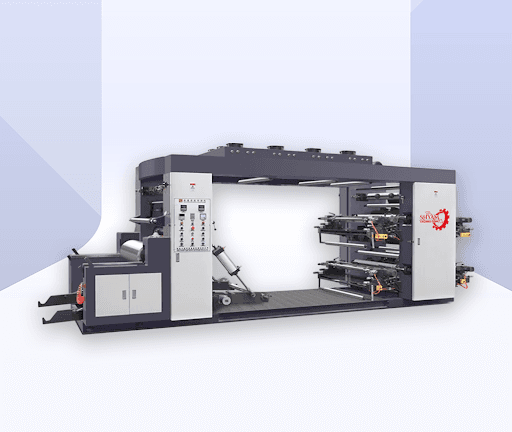
A Flexo Printing Machines, short for flexographic printing machine, prints using a flexible rubber or polymer plate wrapped around a rotating cylinder. An anilox roller meters a precise, even film of ink onto that plate before it touches the material — which is what makes flexo so good at printing on surfaces that don't absorb ink easily, like plastic film, foil, and non-woven fabric.
This is the technology behind most of the flexible packaging you see every day: snack wrappers, non-woven shopping bags, courier pouches, and printed films. Because the ink transfer is so controlled, flexo handles both absorbent materials like paper and non-absorbent ones like LDPE and HDPE film without switching machines.
Four components work together in sequence on every flexo press. Understanding each one helps you ask the right questions before you buy.
A flexible plate, usually rubber or photopolymer, carries the raised image area that will contact the material.
This roller has thousands of tiny engraved cells that pick up ink and deposit a controlled, uniform amount onto the printing plate — this is what prevents over-inking and smudging.
The material being printed is pressed between the plate cylinder and the impression cylinder, transferring the design onto the surface with consistent pressure.
A hot air dryer sets the ink immediately after printing, which matters most on non-absorbent materials like film and foil where ink would otherwise smear before it's handled or rewound.
Instead of vague claims about “advanced technology,” here are the documented specifications of the two 4 Color Roll-to-Roll Flexo Printing Machine models we manufacture at our Faridabad facility — the STP-F41200 and the STP-F41300.
| Specification | STP-F41200 | STP-F41300 |
|---|---|---|
| Printing Colour | 4 | 4 |
| Material Feeding Width | 1200 mm | 1300 mm |
| Max Printing Width | 1160 mm | 1250 mm |
| Printing Speed | 10–80 m/min | 10–80 m/min |
| Cylinder Rolls | Anilox Steel | Anilox Steel |
| Gear Drive | Helical | Helical |
| Un-Rewind Roller | Pneumatic Airshaft | Pneumatic Airshaft |
| Un-Rewind Dia | 1000 mm | 1000 mm |
| Drying Type | Hot Air Dryer | Hot Air Dryer |
| Tension Controller | Pneumatic Brakes | Pneumatic Brakes |
| Block Thickness | 1.7 mm | 1.7 mm |
| Ink Type | Water-Base, Solvent | Water-Base, Solvent |
| Total Power | 20 kW | 25 kW |
| Power Supply | 3 Phase / 415V / 50Hz | 3 Phase / 415V / 50Hz |
| Weight Approx | 5500 kg | 6000 kg |
| Dimension (W×L×H) | 2400 × 5200 × 2700 mm | 2600 × 5200 × 2700 mm |
Both models support water-based and solvent inks, which matters if your packaging clients are moving toward eco-friendly ink requirements. The STP-F41300 gives you a wider feeding width if you regularly run larger material rolls, while the STP-F41200 fits production lines where 1200 mm coverage is enough.
Built for simpler, cost-effective jobs — paper bags, basic non-woven bags, and packaging where two colors cover the design requirement.
Our STP-F41200 and STP-F41300 fall in this category. Four-color printing delivers the color depth and image sharpness that premium packaging and branded products typically need.
Designed for continuous, unbroken production runs straight off a material roll — the standard configuration for high-volume packaging lines.
Tuned specifically for shopping bags, carry bags, and other non-woven products where surface texture and ink adhesion behave differently than on paper or film.
Flexo printing machine ability to handle both absorbent and non-absorbent substrates is why it shows up across so many packaging categories:
Five practical questions to work through before placing an order — skipping any of these is the most common reason businesses end up with a mismatched machine.
Check your current and near-future roll widths against the machine's material feeding width and max printing width. The STP-F41200 covers up to 1160 mm of printing width; the STP-F41300 extends that to 1250 mm. Buying short on width means waste at the edges; buying too wide means paying for capacity you won't use.
Both our models run 10–80 meters per minute. Map this against your daily order volume — a machine sitting well above your real throughput needs is capital tied up for no benefit.
Water-based inks are increasingly required by food packaging and export clients on sustainability grounds. Confirm the machine supports both water-based and solvent inks so you're not locked out of either market.
A 2 Color machine costs less to run for simple jobs. If your packaging work regularly needs sharp, multi-tone branding, a 4 Color machine like the STP-F41200 or STP-F41300 pays for itself faster.
These machines draw 20–25 kW on 3-phase power and need a real industrial footprint — the STP-F41300, for instance, needs roughly 2600 mm × 5200 mm × 2700 mm of floor and height clearance. Confirm your electrical supply and floor space before committing.
This is the question we get most often from buyers who aren't sure which technology fits their product line.
| Factor | Flexo Printing | Offset Printing |
|---|---|---|
| Printing Material | Flexible materials (film, foil, non-woven) | Mainly paper-based |
| Printing Speed | High, continuous roll-to-roll | Moderate, sheet-based |
| Packaging Industry Fit | Highly suitable | Limited |
| Multi-Color Printing | Yes | Yes |
| Bulk Production | Excellent | Good |
| Operating Cost | Cost-effective for flexible substrates | Moderate |
If your product is flexible packaging — film, foil, non-woven bags — flexo is almost always the better fit because offset simply isn't built for those substrates. If you're printing primarily on paper sheets in bulk, offset remains a strong option; we manufacture both, so we can guide you toward whichever matches your actual product line rather than pushing one technology by default.
Shyam Techno Print manufacturing facility is registered and located at Plot No. E-26, Gali No. 5E, Industrial Area, Sarurpur, Ballabgarh, Faridabad-121004 (Haryana). This is a working facility, not a marketing address — something worth checking with any manufacturer you're evaluating.
Close to two decades of building this specific category of machine means the design issues that trip up newer manufacturers — web tension control, drying consistency on film, anilox wear — have already been solved in our current models.
The STP-F41200 and STP-F41300 come with published specifications — speed, power draw, weight, dimensions — so you're comparing real numbers against other manufacturers, not marketing language.
We also manufacture Offset Printing Machines, Non-Woven Bag Making Machines, Square Bottom and V Bottom Paper Bag Machines, and Medical Pouch Making Machines. If your production line needs more than one machine type, we can supply a matched set instead of you mixing brands and support contracts.
Installation, operator training, spare parts, and troubleshooting are handled by our own team — not outsourced to a third-party service network.
As a Flexo Printing Machine Manufacturer in Faridabad, we supply machines across Delhi NCR, Haryana, Punjab, Rajasthan, Uttar Pradesh, Gujarat, Maharashtra, and West Bengal.
Buyers evaluating a purchase in 2026 should factor in where the industry is heading:
Our current Flexo Printing Machine Manufacturer in Faridabad models are built with these shifts in mind, including dual ink-type compatibility, so the machine you buy today doesn't fall behind industry expectations within a year or two.
Shyam Techno Print is one of the trusted Flexo Printing Machine Manufacturers in Faridabad, offering advanced technology, durable machines, and reliable after-sales support.
Shyam Techno Print manufactures high-performance Flexo Printing Machines in India for paper, non-woven fabric, plastic films, and flexible packaging materials.
A Flexo Printing Machine is used for printing logos, images, and designs on paper, plastic films, foil, non-woven fabric, and packaging materials.
Flexo Printing Machines can print on paper, non-woven fabric, plastic films, foil, LDPE, HDPE, and various flexible packaging materials.
The common types include 2 Color Flexo Printing Machine, 4 Color Flexo Printing Machine, Roll to Roll Flexo Printing Machine, and Non-Woven Flexo Printing Machine.
The price depends on machine size, printing speed, number of colors, automation level, and production capacity.
Flexo Printing is generally preferred for flexible packaging and high-speed production, while Offset Printing is mainly used for paper-based commercial printing.
Printing speed varies by model, but modern machines generally offer speeds ranging from 10 to 80 meters per minute or more.
Shyam Techno Print offers advanced technology, durable machines, competitive pricing, and more than 17 years of experience in manufacturing printing and packaging machinery.
Yes, we provide complete installation assistance, operator training, technical guidance, spare parts, and after-sales support.